
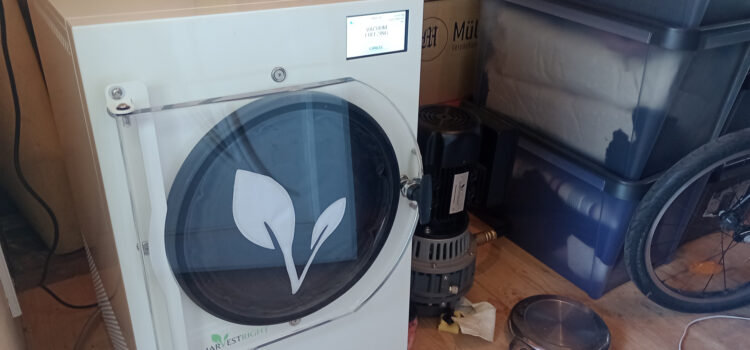
Not everyone named Frosty has to be a snowman.
“Oh cool, you have a freeze dryer! I’ve been thinking about buying a dehydrator or a freeze dryer myself!”—That, or something similar, was a common reaction to my new “family member”, which I named “Frosty” on a friend’s suggestion.
In the U.S. and Canada, this device is already much more widespread—probably mainly because of the large prepper community—but in Europe, it’s not yet very well known, at least for home use. My guess is that it’s mainly due to its size and price. Both of these factors have surprised most people – including myself.
Don’t call it “Dehydrator”!
Even though freeze-drying is also a form of preservation through drying, it differs significantly from other methods in both the process and the end product. In simple terms, drying involves slowly removing moisture using low heat. During this process, the product shrinks and usually changes color as well. Depending on the fruit and method, it often remains soft and pliable nonetheless.
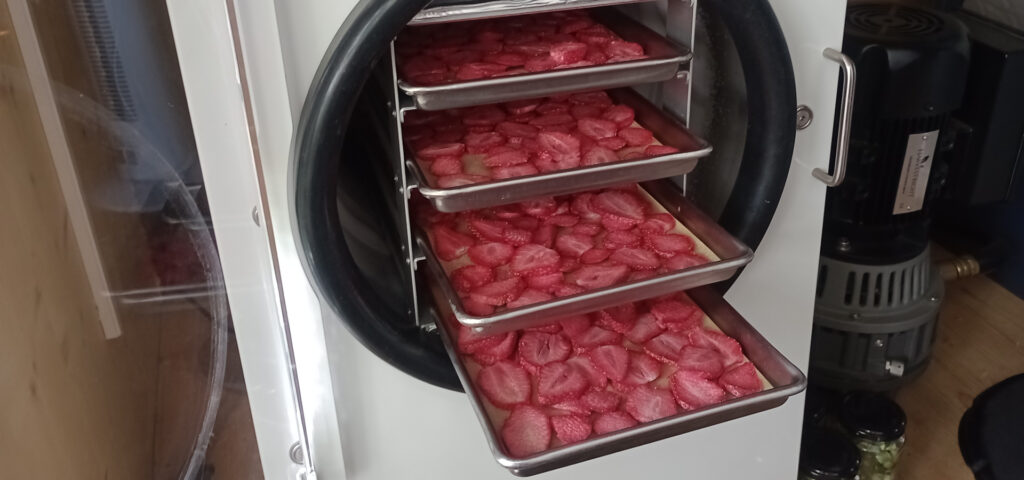
In freeze-drying, the product is first cooled to a very low temperature (at least -30°C), and then a vacuum is created that somehow draws out the liquid. After that, the product—whatever you want to dry—is dried with low heat. I still don’t fully understand the process, so I don’t want to spread half-truths here, but that’s the general idea. Afterward, the product usually retains the same shape and color as when it was fresh, but in many cases it crumbles easily because it’s so dry.
Pros and Cons
Even though freeze-drying is often touted in some circles as the ultimate solution—since food can potentially be stored for up to 25 years—I’ve already noticed a few drawbacks after just a few weeks of using it.
Sensitivity to Oxygen
Since the freeze-dried end product is completely dry, you have to be especially careful not to leave it exposed to the air and oxygen for too long. As soon as it absorbs moisture from the air, it quickly becomes soft and loses its shelf life more rapidly.
Furthermore, it is then no longer suitable as a snack because it has lost its “crunch” factor. However, rehydration should still be possible. I still need to conduct tests to determine more precise time frames and gather further information.
Loud and Hot
In addition, the freeze dryer is much louder than a dehydrator and gives off a tremendous amount of heat into the room. Since I’ll be drying most of my fruit during a season when it’s warm outside as well, I’ll need to figure out a suitable way to cool the room, especially for the summer.
Power Consumption
High power consumption is also often cited as a drawback. And it’s true that the freeze dryer uses more electricity than a dehydrator. Depending on the model, this can range from 50% more to three times as much.
On the other hand, the freeze dryer may run for a shorter time. My tests so far, for example with asparagus, had an average total runtime of about 20 hours. Dehydrators—especially for products that contain a lot of water, like asparagus—can easily run for 48 hours or longer. However, since I haven’t made a direct comparison, these times are purely speculative at this point.
At the same time, it always depends on what we’re comparing it to. For example, if we use an electric space heater to heat our living space in the winter, the freeze dryer will use a little to a lot less electricity, depending on the heater’s wattage. So it’s all relative…
Everything? – Almost everything.
Unlike a dehydrator, virtually anything can be freeze-dried. Not just fruits and vegetables, but also soups, milk, meat, complete meals, and much more. Only fatty foods and honey are unsuitable, as they can potentially cause a lot of unnecessary problems.

Rehydrating makes it almost like new
Even though I still have little experience with rehydration and can therefore only speak from my research so far, it should be possible to “recharge” pretty much all foods with water, and then they should taste just as fresh as before. I lack the experience for this yet, but it holds a lot of potential.
Price and Size
As mentioned at the beginning, the price and size in particular are very surprising to most people. While automatic dehydrators sometimes start at €30 and can go up to €200 or so, the smallest freeze dryer starts at around €3,000 and then increases in increments of thousands up to €8,000 if we want larger models.
And as for size: dehydrators are about the size of microwaves or slightly larger. The smallest freeze dryer (the model I have) is about the size of a washing machine, and then there’s the vacuum pump next to it, which is about the size of a small trash can.
Do I really want this?
Anyone who enjoys freeze-dried products like strawberries, raspberries, etc., or even ready-to-eat meals for hiking has probably often wondered why they’re so much more expensive than simply dried ones. After reading all this information, it’s becoming increasingly clear – to me at least -, why that is.
I definitely thought long and hard about whether I really wanted a device like this. But since I’m not just having it for my own use, but also making it available to others for rent (currently only upon request), as well as planning to produce my own products for sale, my investment should pay off sooner or later.
My initial conclusion, now that I’ve had Frosty for about a month and am currently on my fifth run, is: a really cool—albeit expensive—gadget with a lot of potential. But I still have a lot to learn, and it could all be for nothing if I make mistakes with storage…