
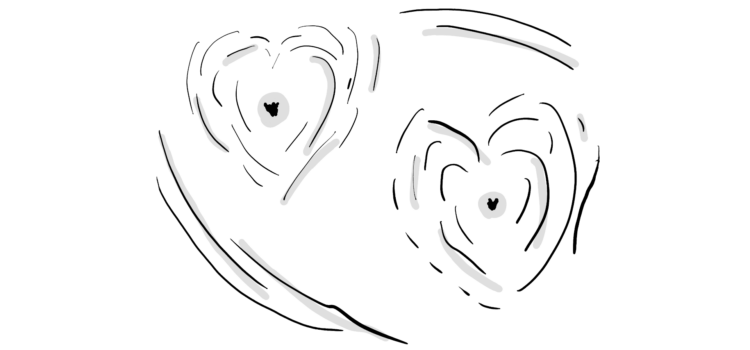
We just have to feel what we feel
For the whole of last year, I felt trapped. Trapped in a cycle of regret, hope, and despair. I had clung to an idea of how both the other person and I—and our relationship—should be, and what I absolutely “needed.” And clinging to this idea of “perfect” didn’t really allow me to see or feel things as they are in their entirety.
Then, a dear friend shared a song with me that let me take a deep breath and allowed the tears to flow in a different way: “You Don’t Need to Be Perfect” by Nash Blackwood.
It sums up in simple words everything I want to say to that other person, what I wanted to hear from them, and what a relationship means to me. Basically, I could just copy the entire song lyric here and everything would be said. And yet, I’ll try to find my own words for it.
Because the biggest obstacle in any relationship (no matter if romantic or otherwise) is all the inner barriers we build—consciously or unconsciously—to avoid having to confront our deepest fears. And my mission is to discover all these barriers and, to tear them down, piece by piece, if they no longer serve me.
Old Emotional Wounds
Old emotional wounds and traumas are experiences that were never fully resolved or processed. These very often give rise to strong beliefs and projections about what the world and other people are like, and about what we must or must not do to ensure we never have to feel the pain of that experience again. When such an old, unhealed wound is touched, it is associated with a strong emotional charge.
When we’re right in the middle of it, it’s as if we’re emotionally catapulted back into the situation of the original wound (usually from childhood). We are then 100% convinced that a situation is exactly as it is, and that the other person, a thing, or “the evil world” is to blame for how I feel. It feels more real than almost anything else. And in this situation, there’s usually a great deal of perceived clarity. Clarity that only something on the outside needs to change, and then I’d be fine again.
It’s like if I had severe burns, and you gently stroke them with a feather because you don’t know there are burns there. For others without a wound, that might feel really good at best, and at worst, a little uncomfortable or ticklish. But nothing serious.
But for me, with this burn, it can quickly feel like you should have been able to see from a distance that there was a burn there. And you must know how a burn feels and, therefore, what you can and can’t do.
And if you then brush over it with the feather anyway—and it naturally feels to me like sharp needles tearing everything open again and making it much worse—I can’t help but condemn you for how terrible and cruel what you did really was.
My job in this situation, however, is to recognize that you aren’t to blame for my wound, and that it’s my responsibility to take care of my wound instead of blaming you.
The crux of the matter is the hidden “but”
However, if I—as the person with the wound—don’t immediately recognize the situation correctly, or don’t want to, or if it’s still too painful to confront it and look at the wound, and I therefore react defensively at first before I can eventually calmly tell you what I need, that can also trigger a reaction in you.
Then a (usually somewhat defiant) thought can easily arise, such as: “Yes, BUT he has to take care of healing his own wounds or tell me what he needs. I’m not the bad one!” This is then a frustrating, but usually very clear sign that there is also projection and pain on your part.
Maybe it’s because of the different perspective; maybe it’s because it would be too painful to truly look within ourselves. But it’s almost always the case that we can see the other person’s wounds more easily.
But even if, viewed purely objectively, it may indeed be true that a functioning relationship also requires the other person to tend to their own wounds, it’s not up to us to define whether, when, and how they do so.
Then it’s a matter of letting go of the idea of what kind of relationship—with what intensity and depth—might be possible, and recognizing what is actually possible. Then we can still decide whether that’s still right for us or not.
But there’s no longer a struggle. No attack on the other person. Then we can walk away in peace, or let the other person walk away in peace. But this peace only comes when we look more closely and can see what this is really about.
If we close our eyes to it…
…we may no longer see the wound, but it’s still there. And it still hurts. We just don’t know why, or how we can do anything about it. And we don’t see the people around us either—neither those who come to rub salt in the wound, nor those who want to apply ointment. As a result, everything will feel like an attack, and true healing cannot take place.
Laying Down Our Weapons
At first, both parties usually feel they are in the right and misunderstood. This leads to a standstill and a dead end from which we can no longer escape. Then it becomes necessary to let go of the need to “be right” and the need to “be perfect,” and instead to feel what lies within us beneath the blame and projection.
There is usually pain, fear, anger, and/or sadness. Only when we have arrived at these original feelings and can sense them in our bodies does the inner struggle—and thus the outer one as well—cease, and peace can settle within us. Then our wound can heal. Not perfectly, but genuinely. Human.
Peace doesn’t come by banishing all the feathers in the world and shutting everyone out, but by applying ointment to the wound, wearing a bandage for a while as protection, or—if it’s a truly deep injury—perhaps seeing a doctor who can clean it more thoroughly and offer advice on how to manage and care for the wound so it can heal properly.
Staying in it when it hurts and is hard
There’s a very important line in the song that speaks to where relationships often fail: “And I don’t need you to fix me, I don’t need you to save my heart, I just need you when I’m breaking, to stay right where you are.”
Simon Sinek also describes it beautifully when he says that we simply have to sit in the mud with the other person. But if, for example, I’m in pain, and you feel your own pain because of mine and run away—which might then trigger pain in me as well—then we’re usually just left alone with our own pain and learn that no one can help us anyway. This reinforces our beliefs that the world, people—men, women, or whoever—are exactly as we’ve always thought them to be.
But if we don’t run away—if we simply pause the behavior that triggered the pain for a moment and just sit down next to each other—healing can happen. Then we can tend to our wounds and help them heal better. And on top of that, we’re truly and authentically present with one another, which strengthens our connection and mutual trust.
Then, step by step, we reveal ourselves with all our wounds and come to know the other’s wounds. Then we can learn how to treat each other in a way that helps our wounds heal even better. Then we can apply the healing salve to the other person wherever they can’t quite reach on their own. Then we can hold each other’s hands when it hurts especially badly, or simply not feel so alone because we know the other person is going through similar processes. And eventually, we can also see how beautifully the wound has healed and recognize even the scars as beautiful. Because they tell our shared story.
The Path Through
I’ve been on my healing journey for a while now, and so I’ve often communicated to my system that I want to see and feel even the things that feel truly awful. Because I know what at the end of it is the feeling of peace and expansiveness.
But in the moment of experiencing it, my whole body feels as if it’s breaking apart. It feels as if I’m trapped inside myself and am my own worst enemy, from whom I cannot escape.
And these feelings are incredibly hard for me to bear. But it’s like training our muscles. With each attempt, I get a little further, until eventually I’ll be able to do a pull-up.
Sometimes, when it feels like the process is breaking me, I wonder if it wouldn’t be much easier to hide away alone in a cave and just give up. Then I think that all this painful ointment-applying or wound-cleaning doesn’t do any good anyway, except cause a lot more pain. And that it would be easier to just somehow endure this mild, underlying pain for the rest of my life.
After all, I’ve managed to get this far with these numbed feelings. And so many other people in this world are walking around with their wounds, too, and get upset when someone touches them. Why can’t I just keep doing the same thing and blame others or my circumstances?
In these situations, it helps me to see where my wounds have already healed a little—or even completely—because I’ve faced them head-on and not turned a blind eye to them. And how much more pleasant my life is now that I no longer have to live in constant fear of some kind of pain. And how much more colorful life is since I’ve kept my eyes open—allowing me to see not only the wounds but also all the other things in the world.
Hope, Regret, and Despair Are the Prison
After this past year in the prison I built for myself out of hope, regret, and despair, I have now found the door. I always had the key inside me anyway. Now it’s time to rediscover my freedom.
Because even though, in my own mind, I was absolutely convinced that I had to stay in that prison for my relationship to work, I can now see that it was precisely that prison that kept me from making it work.
And I can also recognize that this relationship isn’t really with anyone else, but above all, it’s the relationship with myself.



Deeply insightful. Thank you for the sharing.
Thank you so much for that lovely feedback.